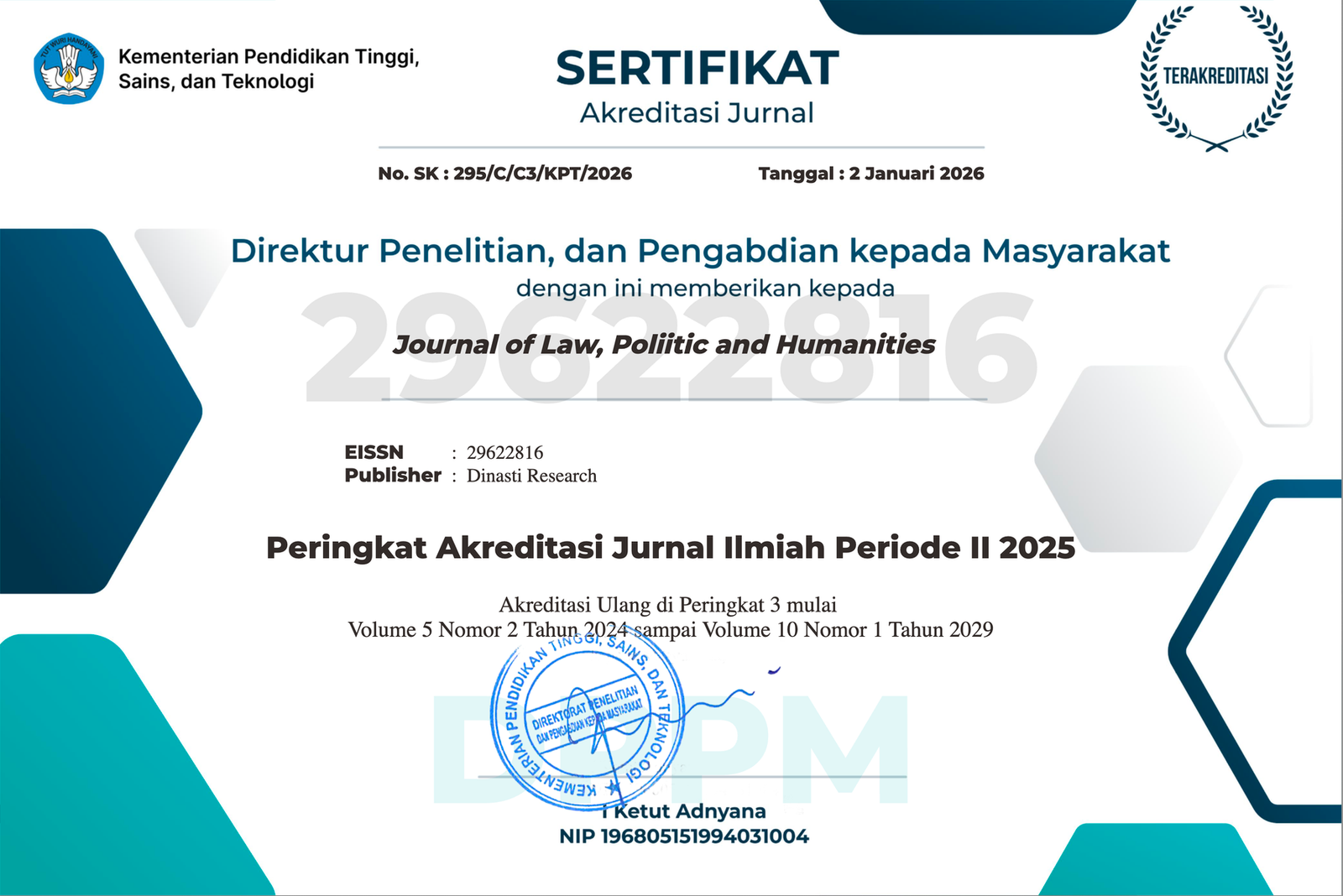
Beyond Single-Axis Protection: Reconstructing Labor Law for Disabled Women in Outsourcing Relations
DOI:
https://doi.org/10.38035/jlph.v6i5.3671Keywords:
intersectional discrimination, disabled women workers, outsourcing law, reasonable accommodation, Indonesian labor lawAbstract
Outsourcing arrangements place workers inside a triangular relationship. That relationship connects a principal company, an outsourcing agency, and the worker herself. Female workers with disabilities face a compounded disadvantage inside this structure. Their gender exposes them to wage discrimination. Their disability exposes them to exclusion from workplace accommodation. Indonesian labor law addresses gender, disability, and outsourcing status through three separate legal instruments. No prior study examines how these three conditions interact for a single worker. This research aims to reconstruct Indonesian labor law so that it treats this compounded condition as one distinct legal category. The research applies normative legal methods. It combines a statute approach with a conceptual approach. The statute approach examines Indonesian legislation, government regulations, and court decisions. The conceptual approach draws on intersectionality theory and the social model of disability. The results show that Indonesian law regulates disability, gender, and outsourcing status through three parallel tracks. These tracks never intersect. This separation produces a protection gap for disabled women placed through outsourcing agencies. The research proposes a reconstructed legal standard built on four components. These components are joint liability between the principal company and the outsourcing agency, a unified complaint procedure, grounding in international human rights instruments, and a statutory redefinition of employer status. This reconstruction gives Indonesian lawmakers a concrete pathway toward closing a protection gap that current law leaves invisible
References
Ana Martin. (2024). “The Efficiency of Intersectionality: Labelling the Benefits of a Rights-Based Approach to Interpret Sexual and Gender-Based Crimes.” Human Rights Review, 25(no.1), 1–24. https://doi.org/https://doi.org/10.1007/s12142-024-00714-x
Ana Martin. (2025). “Intersectional v. Narrow Approaches to Sexual and Gender-Based Crimes: Contrasting Outcomes and Gleaning Useful Techniques.” International Criminal Law Review, 25(no.1), 82–111. https://doi.org/https://doi.org/10.1163/15718123-bja10220
Anjan Ray Chaudhury and Madhabendra Sinha. (2020). “Does Education Produce Identical Labour Market Outcomes for All? A Study on India.” Margin, 14(no.3), 309–331. https://doi.org/https://doi.org/10.1177/0973801020920095
Anna Lawson and Angharad E. Beckett. (2020a). “The Social and Human Rights Models of Disability: Towards a Complementarity Thesis.” In International Journal of Human Rights. https://doi.org/https://doi.org/10.1080/13642987.2020.1783533
Anna Lawson and Angharad E. Beckett. (2020b). “The Social and Human Rights Models of Disability: Towards a Complementarity Thesis.” International Journal of Human Rights, 1–32. https://doi.org/https://doi.org/10.1080/13642987.2020.1783533
Catriona Cannon. (2023). “Muslim Women in the Workplace and the Equality Act 2010: Opportunities for an Intersectional Analysis.” International Journal of Discrimination and the Law, 23(no.3), 185–215. https://doi.org/https://doi.org/10.1177/13582291231176513
Constitutional Court, Decision No. 168/PUU-XXI/2023 (2024). https://s.mkri.id/public/content/persidangan/putusan/putusan_mkri_11215_1730375514.pdf
Convention on the Rights of Persons with Disabilities, art. 27 (2006). https://doi.org/https://www.un.org/development/desa/disabilities/convention-on-the-rights-of-persons-with-disabilities.html
Crenshaw, K. (1989). “Demarginalizing the Intersection of Race and Sex: A Black Feminist Critique of Antidiscrimination Doctrine, Feminist Theory, and Antiracist Politics.” University of Chicago Legal Forum, no.1, 139–167. https://doi.org/https://chicagounbound.uchicago.edu/uclf/vol1989/iss1/8
Damian Grimshaw, Jo Cartwright, Arjan Keizer, and J. R. (2019). “Market Exposure and the Labour Process: The Contradictory Dynamics in Managing Subcontracted Services Work.” Work, Employment and Society, 33(no.1), 76–95. https://doi.org/https://doi.org/10.1177/0950017018759206
Damian Grimshaw et al. (2019). “Market Exposure and the Labour Process: The Contradictory Dynamics in Managing Subcontracted Services Work.” Work, Employment and Society, 33(no.1), 76–95. https://doi.org/https://doi.org/10.1177/0950017018759206
David du Toit. (2023). “Paid Domestic Work and Outsourcing in South Africa: Clients’’ Views on Trust, Control and Power Relations".” Current Sociology, 71(no.6), 1063–1081. https://doi.org/https://doi.org/10.1177/00113921211056058
Eun Ha Namkung and Deborah Carr. (2019). “Perceived Interpersonal and Institutional Discrimination among Persons with Disability in the U.S.: Do Patterns Differ by Age?” Social Science and Medicine, 239. https://doi.org/https://doi.org/10.1016/j.socscimed.2019.112521
Evan Kirksey and Kendal Lyssy. (2026). “Organizing Ableism: An Ethnographic Study of Discriminatory Culture in a Disability-Focused Workplace.” Southern Communication Journal, 91(no.2), 156–174. https://doi.org/https://doi.org/10.1080/1041794X.2025.2598744
F. Shalihah, O. Adhayanto, M. Indra, and A. (2022). “Determination of the Maximum Time Limit on a Specific Time Work Agreement in the View of Legal Certainty and Fairness.” Economic Annals, XXI.
Gabungan Serikat Buruh Indonesia (GSBI). (2026). “Pernyataan Sikap GSBI atas Terbitnya Permenaker Nomor 7 Tahun 2026 tentang Pekerjaan Alih Daya.” https://www.infogsbi.or.id/2026/05/pernyataan-sikap-gsbi-atas-terbitnya.html.
Government Regulation Number 35 of 2021 (2021).
Hardius Usman and Nucke Widowati Kusumo Projo. (2021). "Encouraging Entrepreneurship for People with Disabilities in Indonesia: The United Nations’ ‘Leave No One Behind’ Promise",. Journal of Population and Social Studies, 29, 195–206. https://doi.org/https://doi.org/10.25133/JPSSV292021.012
I Gede Ayusta Dharma Ginonggara and Marwati Riza. (2026). "Assessing Outsourced Workers’ Normative Rights Protection in the Electricity Sector Following Labor Policy Reform". Media Iuris, 9(no.1), 49–78. https://doi.org/https://doi.org/10.20473/mi.v9i1.80034
International Labour Organization. (1958). Convention Concerning Discrimination in Respect of Employment and Occupation (No. 111). https://doi.org/https://www.ilo.org/dyn/normlex/en/f?p=NORMLEXPUB:12100:0::NO::P12100_ILO_CODE:C111
Janet E. Lord. (2023). “Accounting for Disability in International Humanitarian Law.” International Review of the Red Cross, 105(no.922), 60–98. https://doi.org/https://doi.org/10.1017/S1816383122001072
Katja Karjalainen and Marjo Ylhäinen. (2021a). “On the Obligation to Make Reasonable Accommodation for an Employee with a Disability.” Uropean Labour Law Journal E, 12(no.4), 547–563. https://doi.org/https://doi.org/10.1177/20319525211027430
Katja Karjalainen and Marjo Ylhäinen. (2021b). “On the Obligation to Make Reasonable Accommodation for an Employee with a Disability.” European Labour Law Journal, 12(no.4), 547–563. https://doi.org/https://doi.org/10.1177/20319525211027430
Kimberlé Crenshaw. (1989). “Demarginalizing the Intersection of Race and Sex: A Black Feminist Critique of Antidiscrimination Doctrine, Feminist Theory, and Antiracist Politics.” University of Chicago Legal Forum, no.1, 139–167. https://doi.org/https://chicagounbound.uchicago.edu/uclf/vol1989/iss1/8
Laetitia Fourie and Anri Botes. (2018a). “Disability Discrimination in the South African Workplace: The Case of Infertility,.” International Journal of Human Rights, 22(no.7), 910–932. https://doi.org/https://doi.org/10.1080/13642987.2018.1485657
Laetitia Fourie and Anri Botes. (2018b). “Disability Discrimination in the South African Workplace: The Case of Infertility.” International Journal of Human Rights, 22(no.7), 910–932. https://doi.org/https://doi.org/10.1080/13642987.2018.1485657
Laura Spura Rodriguez and Stephanie A. Bryson. (2026). “‘Living on the Outskirts of Things:’ Women and Nonbinary People of Color with Cognitive Disabilities Describe Their Employment Experiences.” In Qualitative Social Work. https://doi.org/https://doi.org/10.1177/14733250261429175
Law Number 13 of 2003 on Manpower., art. 6 (2003).
Law Number 13 of 2003 on Manpower, art. 5. (2003).
Law Number 13 of 2003 on Manpower, Elucidation of art. 5 (2003).
Law Number 8 of 2016 on Persons with Disabilities, 2016 No. 69, art 5 (2016).
Law Number 8 of 2016 on Persons with Disabilities, art. 11 (2016).
Law Number 8 of 2016 on Persons with Disabilities, art. 53 (2016).
Maria Sagmeister. (2026a). “Legal Mechanisms of Invisibilisation: Exclusion and Differentiation.” Feminist Legal Studies. https://doi.org/https://doi.org/10.1007/s10691-025-09594-z
Maria Sagmeister. (2026b). “Legal Mechanisms of Invisibilisation: Exclusion and Differentiation.” Feminist Legal Studies. https://doi.org/https://doi.org/10.1007/s10691-025-09594-z.
MariaCaterina La Barbera, Laura Cassain, and P. C. (2024). “The Discursive Construction of Intersectionality in Public Policy Implementation.” Critical Discourse Studies, 21(no.5), 555–572. https://doi.org/https://doi.org/10.1080/17405904.2023.2228937
Natalie Videbaek Munkholm. (2022). “Multiparty Work Relationships in Denmark: The Active Role of Social Partners,.” European Labour Law Journal, 13(no.4), 515–529. https://doi.org/https://doi.org/10.1177/20319525221131184
Nu Nguyet Anh Nguyen and Thi Phuong Uyen Nguyen. (2026). “Deserving but Dismissed: Employment Challenges for Women with Disabilities in Vietnam.” Employee Relations, 1–13. https://doi.org/https://doi.org/10.1108/ER-06-2025-0487
Patrick Button, Mashfiqur R. Khan, and M. P. (2022a). “Do Stronger Employment Discrimination Protections Decrease Reliance on Social Security Disability Insurance? Evidence from the U.S. Social Security Reforms,.” Journal of the Economics of Ageing, 22. https://doi.org/https://doi.org/10.1016/j.jeoa.2022.100370
Patrick Button, Mashfiqur R. Khan, and M. P. (2022b). “Do Stronger Employment Discrimination Protections Decrease Reliance on Social Security Disability Insurance? Evidence from the U.S. Social Security Reforms.” Journal of the Economics of Ageing, 22. https://doi.org/https://doi.org/10.1016/j.jeoa.2022.100370
Raymond Taruvinga and Taruvinga Muzingili. (2026). “Navigating the Triple Constraints: Post-Vocational Training Experiences of Self-Employed Women with Disabilities in Zimbabwe.” Social Sciences and Humanities Open, 14. https://doi.org/https://doi.org/10.1016/j.ssaho.2026.103132
Regulation of the Minister of Manpower Number 7 of 2026 on Outsourced Work.
Rème-Harnay, P. (2024). “Precarity and Subcontracting Relationships: The Case of Parcel Delivery Drivers in France,” 38, no. 3 (2024): ,. Work, Employment and Society, 38(no.3), 596–614. https://doi.org/https://doi.org/10.1177/09500170221142721
Samimi, N. Jefferson, S. Flanagan, and Y. Anyon. (2023). Intersections of Disproportion: A Critical Quantitative Examination of Dis/ability and Gender in Black Students’ School Discipline Outcomes,". Urban Review. https://doi.org/https://doi.org/10.1007/s11256-023-00657-6
Sara La Vecchia. (2023). “The Protection of Women and Girls with Disabilities in Armed Conflict: Adopting a Gender, Age and Disability Inclusive Approach to Select IHL Provisions.” International Review of the Red Cross, 105(no.922), 161–191. https://doi.org/https://doi.org/10.1017/S1816383122000765
Sarbini, Hufron, and C. (2026). “The Concept of Legal Protection of Outsourced Workers to Realize Worker Welfare.” Jurnal Hukum Bisnis Bonum Commune, 9(no.1). https://doi.org/10.30996/jhbbc.v9i1.132483
Shandra G. Benito, Thomas S. Glassman, and B. G. H. (2016). “Disability and Labor Market Earnings: Hearing Earnings Gaps in the United States,.” Journal of Disability Policy Studies, 27(no.3), 178–188. https://doi.org/https://doi.org/10.1177/1044207316658752
Simon Darcy, Tracy Taylor, and J. G. (2016). “‘But I Can Do the Job’: Examining Disability Employment Practice through Human Rights Complaint Cases,.” Disability and Society, 31(no.9), 1242–1274. https://doi.org/https://doi.org/10.1080/09687599.2016.1256807
Stephen Thompson, Brigitte Rohwerder, and D. M. (2023). “Disability, Religion, and Gender: Exploring Experiences of Exclusion in India through an Intersectional Lens.” Social Inclusion, 11(no.4), 314–325. https://doi.org/https://doi.org/10.17645/si.v11i4.7129
Tavee Cheausuwantavee and Sakulthip Keeratiphanthawong. (2021). “Employment for Persons with Disabilities in Thailand: Opportunities and Challenges in the Labor Market.” Journal of Population and Social Studies, 29, 384–400. https://doi.org/https://doi.org/10.25133/JPSSv292021.024
United Nations. (2006). Convention on the Rights of Persons with Disabilities. https://doi.org/https://www.un.org/development/desa/disabilities/convention-on-the-rights-of-persons-with-disabilities.html
Ylhäinen, K. K. and M. (2021). “On the Obligation to Make Reasonable Accommodation for an Employee with a Disability.” European Labour Law Journal, 12(no.4), 547–563. https://doi.org/https://doi.org/10.1177/20319525211027430
Downloads
Published
How to Cite
Issue
Section
License
Copyright (c) 2026 Tri Nurhayati, Riza Fibriani, Bagas Heradhyaksa, Haiyyu Darman Moenir

This work is licensed under a Creative Commons Attribution 4.0 International License.
Authors who publish their manuscripts in this journal agree to the following conditions:
- The copyright on each article belongs to the author(s).
- The author acknowledges that the Journal of Law, Poliitic and Humanities (JLPH) has the right to be the first to publish with a Creative Commons Attribution 4.0 International license (Attribution 4.0 International (CC BY 4.0).
- Authors can submit articles separately, arrange for the non-exclusive distribution of manuscripts that have been published in this journal into other versions (e.g., sent to the author's institutional repository, publication into books, etc.), by acknowledging that the manuscript has been published for the first time in the Journal of Law, Poliitic and Humanities (JLPH).